It struck me that, if you were to write a novel on a blog, you should start at the end and work back. Readers would hit it at whatever point the story had got to, and then read on, which is of course backwards.
But anyway, endings and beginnings are indistiguishable. How about:
Japonica closed the door behind her and stepped out into the early morning. No-one was around and every single early bird was boasting loudly about the worm it had caught.
Japonica had finally got rid of hers. She pushed the house keys back through the letterbox.
She walked towards the station. The first train, she told herself, wherever.
Or:
Kelvin dusted the loose earth from his trousers as he stood up. He looked down into his father's grave, looked at the little brass name plate, the pale, cheap coffin, the scattering of loose earth across it. His soul was cold inside him.
He looked around. His aunt was hovering. He hadn't asked her to look after him. He was fifteeen. He was the man now.
Two grave diggers loitered just in sight, waiting for them to leave. As though they could undo their morning's work.
Two of her friends were comforting his mother. Her knees seemed bent, as though about to buckle. She needed her friends to hold her up. She was weak, he thought savagely. Weak.
At that point, as water turns to ice, his future was determined. All his uncertainty coalesced into clear, sharp purpose. He knew what he had to do. He would find the people who did this to his father and he would kill them.
Monday, November 13, 2006


Friday, November 10, 2006
Eight invisible things
Eight imperceptible things we can't live without:
Time
Love
God
Self
Childhood
Consciousness
What's over the horizon
Death
Love
God
Self
Childhood
Consciousness
What's over the horizon
Death
Thursday, November 09, 2006
Day out in Lincoln
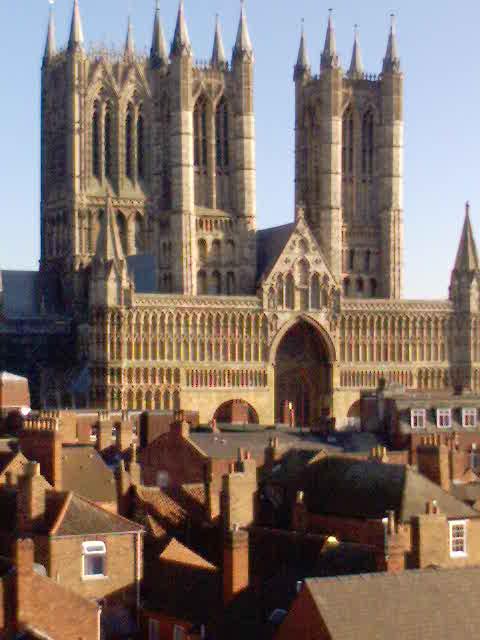 An excellent day out in Lincoln - this is a view of the Cathedral from the Castle. All credit to the photographer, Joanna Bagshaw.
We had an hour's guided tour round the Cathdral which was informative and genial (a small group, being November).
The Castle includes the Georgian and Victorian prison. Religion looms large. The chapel is a highlight, designed to enable prisoners to be preached at without seeing or speaking to anyone else. There's also a projection of the chaplain bullying a prisoner to confess her guilt before her execution - that she was not guilty merely hightened the poignancy.
The Magna Carta wasn't there, though the facsimile seemed to need the same security and environmental controls as the original. There was a sign saying that the original was on tour in America and apologising for any disappointment (for us, or for them?).
And I liked the final sign, just as we were leaving:
To the Condemned Cell
Way Out.
one heart and mind
I regularly use the phrase 'let us pray with one heart and mind' (it's in the prayer book I use).
And it's been worrying me.
As an aspiration I have no problem with it. It seems to me right, even a spiritual duty, that we should struggle towards personal integrity of life (body, mind and soul), and towards integrity of our life with the will and Spirit of God (always recognising that this is an unattainable goal, at least in this world).
But there is an edge of spiritual blackmail about the phrase when it comes to praying together. Does it mean, perhaps: 'I want all of you praying with me to agree with me.'?
Or does it mean: if we are not in agreement then our relationships with God, and hence these prayers, are all diminished?
I suspect the idea stems from the common-sense syllogism that:
In fact the desire for unity is a powerful force for division. The more that conservatives insist that ECUSA and the Anglican Communion must embody their agenda the more they destroy the faith they have inherited from the saints. Anglicans Online (always full of common sense) has this reflection on the notion that 'our church has been taken away from us'.
The desire for purity denies the generosity of God. The campaign for a narrow unity divides one Christian from another. The search for certainty becomes idolatry: we set up formulae to articulate an understanding of faith and end up making the words more important than openness to God.
Let us pray in the common cause of worship and service of God, bringing all our gifts, our conflicts, our uncertainties to our sharing together.
After all, just because we're Christian it doesn't mean we have to like one another.
And it's been worrying me.
As an aspiration I have no problem with it. It seems to me right, even a spiritual duty, that we should struggle towards personal integrity of life (body, mind and soul), and towards integrity of our life with the will and Spirit of God (always recognising that this is an unattainable goal, at least in this world).
But there is an edge of spiritual blackmail about the phrase when it comes to praying together. Does it mean, perhaps: 'I want all of you praying with me to agree with me.'?
Or does it mean: if we are not in agreement then our relationships with God, and hence these prayers, are all diminished?
I suspect the idea stems from the common-sense syllogism that:
- We are all Christian believers;
- God is one and undivided; therefore
- All Christian believers should be united. (Disunity is prima facie evidence of a wrong relationship with God.)
In fact the desire for unity is a powerful force for division. The more that conservatives insist that ECUSA and the Anglican Communion must embody their agenda the more they destroy the faith they have inherited from the saints. Anglicans Online (always full of common sense) has this reflection on the notion that 'our church has been taken away from us'.
The desire for purity denies the generosity of God. The campaign for a narrow unity divides one Christian from another. The search for certainty becomes idolatry: we set up formulae to articulate an understanding of faith and end up making the words more important than openness to God.
Let us pray in the common cause of worship and service of God, bringing all our gifts, our conflicts, our uncertainties to our sharing together.
After all, just because we're Christian it doesn't mean we have to like one another.
Wednesday, November 08, 2006
Why Haiku?
Why haiku? Because,
like hand-made sweets, each mouthful
has a new flavour.
Now is already
past. We build giant's castles
on flimsy moments.
like hand-made sweets, each mouthful
has a new flavour.
Now is already
past. We build giant's castles
on flimsy moments.
Tuesday, November 07, 2006
Haiku
Poems in scattered
fragments, each word a half-rhyme
in search of a pair.
A vault full of keys
in all varieties; none
will unlock this door.
fragments, each word a half-rhyme
in search of a pair.
A vault full of keys
in all varieties; none
will unlock this door.
Friday, November 03, 2006
More Haiku
Legal learning was
not a piece of cake, the best
teachers taught taut tort.
This cat didn't hunt,
it slept. And for Sunday lunch
caught Yorkshire puddings.
Brittle days return -
leaves snap, paths scrunch, breath freezes -
words break between us.
not a piece of cake, the best
teachers taught taut tort.
This cat didn't hunt,
it slept. And for Sunday lunch
caught Yorkshire puddings.
Brittle days return -
leaves snap, paths scrunch, breath freezes -
words break between us.
Subscribe to:
Posts (Atom)